
Jannie Lau (right), chair of Radnor Township school board’s policy committee, listens to public comment about the district’s handling of AI-altered images of students at the committee’s Feb. 10 meeting. Board member Susan Stern is to her left. Board member Lon Rosenblum attended virtually.
Nearly two months after five distraught Radnor High School freshman girls told their parents that AI fakes of their sexualized images were making the rounds, authorities charged a 9th-grade boy with criminal harassment.
Case closed?
Hardly.
Radnor parents this week spoke about the lasting damage of AI-generated video on their daughters and families, blasted the incident’s handling by school officials and police, and requested policy changes going forward.
At a packed school board policy committee meeting Tuesday night, one mother, Luciana LiBrandi, asked for immediate changes to district protocols, policy and the student handbook.
Two other parents – a mother and a father who asked to remain anonymous – opened up to SAVVY about their family’s trauma a few days later.
Here are some of the mother’s responses to our questions:
“My daughter called me crying after being interviewed one-on-one by the assistant principal. This occurred after we had specifically requested that we be contacted before any such meeting took place, which did not happen. While crying, she said, “Mom, they think I’m lying,” and asked me to pick her up from school.” [Radnor’s principal and 9th-grade guidance counselor were alerted by a group email from parents shortly after their daughters reported the video, the mother tells SAVVY. According to school officials, two calls also came in to the Safe2Say Something anonymous tipline.]
“Our entire families have been profoundly impacted by what happened. This incident has penetrated every part of our lives … The ripple effects have affected our mental health, our sense of safety, our ability to focus at work and at school, and our overall family stability. The stress has been constant and consuming.
… The most shocking and distressing aspect of this entire experience has been the response of both the school and the police. The communications and emails issued by both … were inaccurate, inappropriate, omitted material facts, and significantly downplayed what had occurred, repeatedly referring to the events as “rumors” and refusing to acknowledge the sexual nature of the images and videos or that a crime occurred.
…At a systemic level, we did not feel heard, respected, or taken seriously. Families repeatedly raised concerns about evidence, investigative steps, and process, and those concerns were not meaningfully addressed.”
The father shared similar concerns with us Friday afternoon. Some of his statements:
“Girls were pulled out of class after the situation was already widely known and visibly escorted to the principal’s office, increasing stigma, exposure, humiliation and distress. This happened despite the parents’ documented request to not interview the girls without speaking to a parent first. They were interviewed 1×1 by a 45 year old male.
…This is not simply a student misconduct story. It is a breakdown in institutional response to digital sexual violence enabled by consumer AI tools, in a state that has already passed a law specifically intended to address this conduct.”
At Tuesday’s night’s policy committee meeting, LiBrandi spoke about the incident’s lasting impact:
“When AI generated or manipulated images and videos are used to sexualize, demean, or humiliate a student, the impact is immediate and lasting. These incidents do not end when a file is deleted, or a message disappears. For a teenager, the emotional and psychological effects can be profound.”
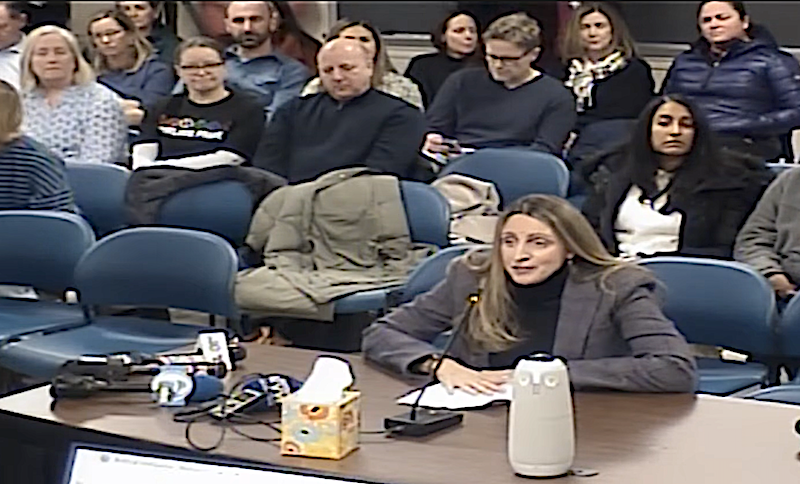
Radnor High School parent Luciana LiBrandi respectfully requests immediate policy changes at the Feb. 10 meeting of the school board’s policy committee.
School officials had hinted that their hands were somewhat tied by board policy because the AI-manipulation took place off-campus.
At the meeting, parents called for new, clear protocols for dealing with non-consensual AI-generated videos shared in the Radnor community, whether they were created on or off school grounds.
They also asked school officials to report such incidents to police without delay. One parent speaker said the alleged harasser admitted his guilt but had ample time to destroy the evidence.
Several called for more transparent, accurate information in the district’s communications with parents.
“We recognize this is new and complex territory,” LiBrandi said. “But doing nothing or relying on public policies written before this technology existed, leave students unprotected. Our goal is prevention, accountability, and the well being of our daughters.”
One father, Adam Dorfman (below), called himself a “confused parent” of four.
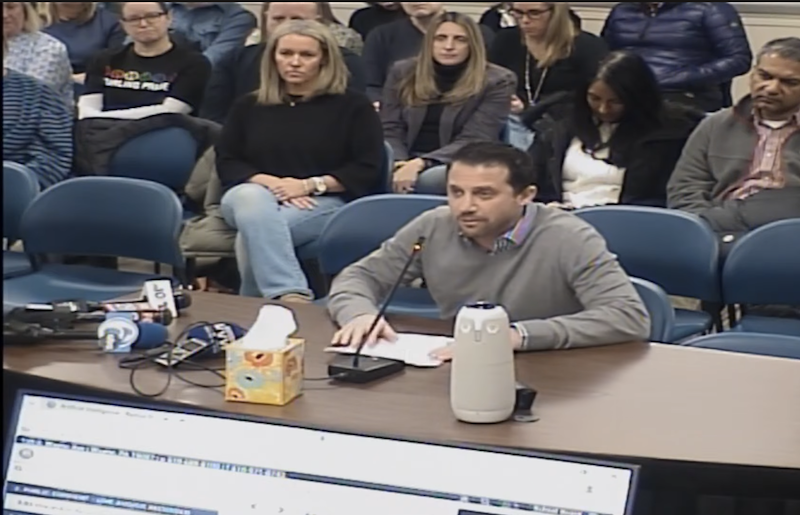
“Students reported something so disturbing that they felt compelled to tell the adults in the room. That matters,” When children come forward, they’re doing exactly what we teach them to do. Speak up, trust adults, ask for help. What they learn next is troubling. Instead of protection, they experience delay. Instead of accountability, minimization, instead of safety, silence. The school labelled this an out-of-school issue even though the harm followed these children into their school day, their classrooms, and their lives. Families were left to push for action, rather than seeing the school step in to protect students as required. So I ask, why is the school refusing to protect and defend children who reported sexual criminal activity that directly affects their safety at school? If students speak up and nothing happens, what lessons have we taught them?”
Radnor Township School District did not immediately respond to our request for comment.
About 30 concerned parents attended Tuesday night’s policy committee meeting. Several weighed in, most showed up to lend moral support.
After public comment, school board members began a detailed review of the pertinent district policies related to bullying, harassment and AI-generated content. The committee expects to review draft changes at its next meeting, set for March 10.
With the help of the school board’s solicitor, policy changes are crafted and approved at the committee level, then go the full board for approval. The process typically takes several months.
The second parent tells us this is Radnor’s opportunity to set the standard for other districts:
“What families are asking for now is not retribution or symbolic action, but concrete, system-level change so the next family is not re-traumatized … This will not be the last school district or police department to face an incident like this. How Radnor chooses to respond now will set a precedent for how schools and communities respond everywhere.”

Thanks, Caroline, for reporting on this critically important issue. I’m surprised that only 30 parents attended the meeting. This is a situation that has mental health and legal consequences that could affect many teens as AI becomes more sophisticated and accessible.