
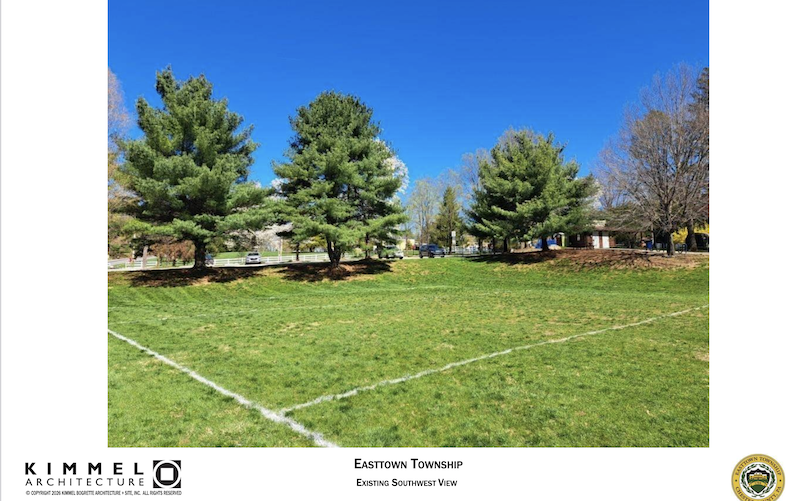
The planned site of a new police and administrative offices for Easttown Township in the northwesterly corner of Hilltop Park.
It just wasn’t sitting right. An “article” headlined “The Future of [Easttown’s] Hilltop Park is Up in the Air” was making the rounds on community Facebook pages, dressed up as legitimate journalism but rife with insinuations and half-truths.
I hadn’t yet dug into the township’s biggest undertaking in years, a new $12 million to $13 million township building for police and staff at Hilltop Park. But I knew enough to know the “article” was suspect.
Another red flag: it had no byline, and it ended with a call to action, urging residents to push supervisors to delay the project at Monday night’s meeting.
Who’s behind it? We may never know. Emails to the website asking who runs it went unanswered.
So on Friday afternoon, I set out to fact-check it. I spent two hours with Easttown Township Manager Don Curley, touring the building and walking the grounds. I read township documents, watched meeting videos and reached out to sources.
Here’s how the project came about, where it stands, and what’s actually up for a vote Monday night. No agenda, no spin.
A gift with strings
Easttown got lucky 30 years ago. In December 1996, Sterg and Frances O’Dell deeded their 23.85 acres at Beaumont and Newtown roads to the township: the Hilltop House mansion, its barn and the surrounding land.
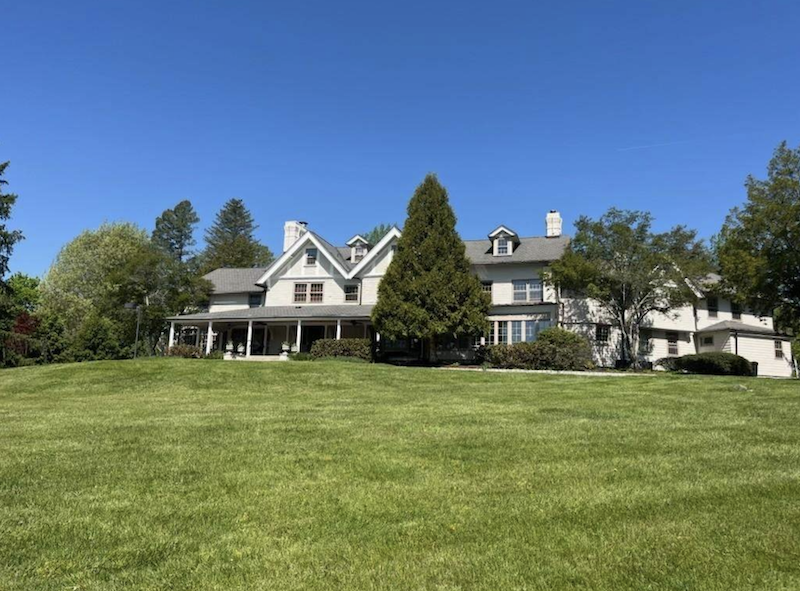
The rear of Hilltop House, a former mansion-turned-events-venue, looks out over parkland.
The gift came with strings. The deed requires the land to be used only for public and municipal purposes, never subdivided, and otherwise kept open and undeveloped. New buildings are limited to those serving the park and fields, such as maintenance sheds. And if the land is ever used for anything other than public or municipal purposes, it goes to Vassar College in Poughkeepsie, N.Y.
The township put the gift to work quickly. Around 1998, it moved its police department and administrative offices out of leased space in a former Berwyn school building and into the converted barn, often called the carriage house. It also built its first park: soccer fields, a walking path, a playground, a picnic pavilion and parking.
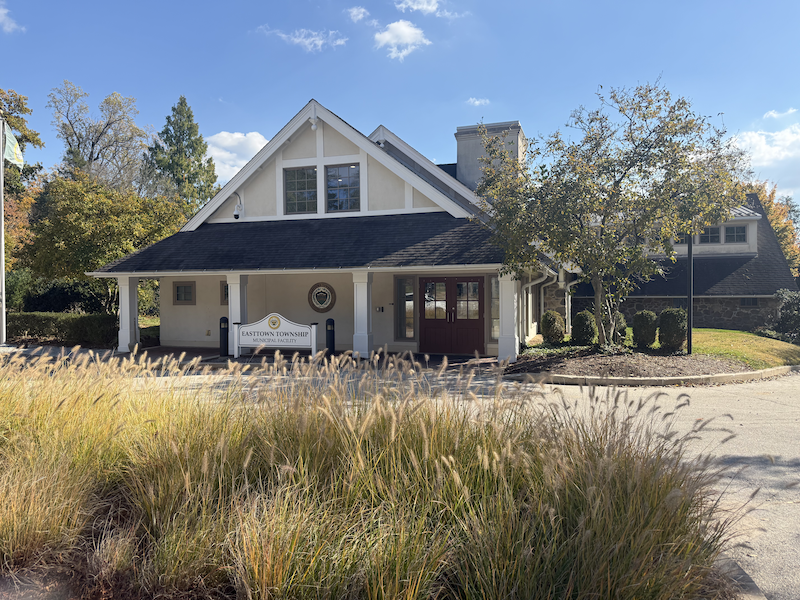
The Hilltop property’s barn/carriage house has housed the township’s administrative offices in front and police station in the rear since the late 1990s.
In 2005, it restored the 1894 mansion as a venue for weddings and events, run by Perfect Setting Catering. The rental income helps offset upkeep.
Too small from day one
The arrangement worked, up to a point. The offices’ biggest problem is a meeting room that’s too small for a township of Easttown’s size. Residents have been left listening from the hallway. In a twist of irony, Curley says, the first meeting on the tax that would help pay for a bigger building had to be canceled because the room couldn’t hold the crowd.
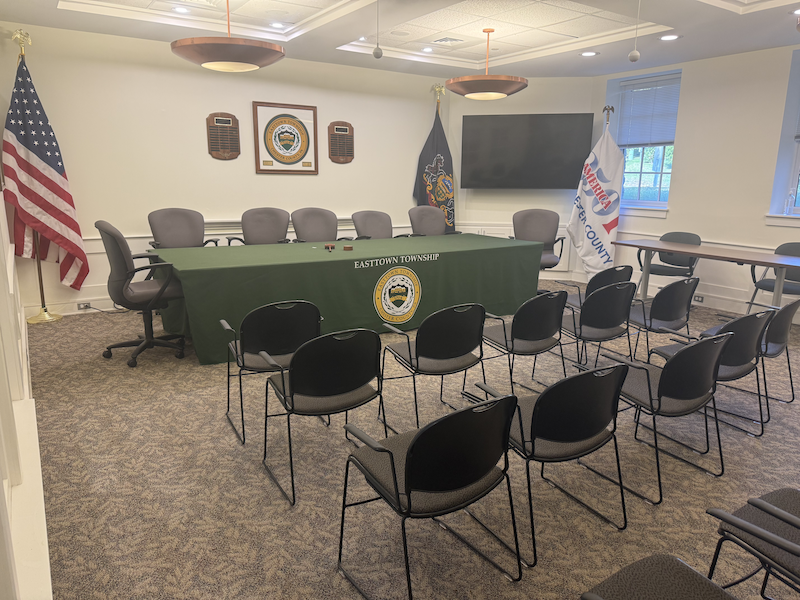
Township meetings are held in this room. If a large crowd is expected, meetings are often moved to Hilltop House next door.
But it was the police station that forced the issue.
“There have been issues from the day we moved there,” David Obzud, the township’s recently retired police chief, told supervisors this past summer. “I was here the day we moved there. It was too small back [then]. The problem was, it just kept getting kicked forward. Nobody wanted to take on this thing.”
Cramped doesn’t begin to cover it.
There’s no interview room where victims, witnesses and suspects can speak privately with detectives. They use a corner of the lobby or, when it’s free, the township conference room.
“Either way, it doesn’t afford much privacy,” Police Chief J. Michael Sesher tells SAVVY. “Some of these residents are reporting things of a personal and sensitive nature.”
There’s no covered sally port for moving prisoners between police cars and the station. The locker room, a former bathroom, is so small that equipment sits unsecured all over the station. (We’d show you, but photos weren’t allowed on our tour.)
When it rains, the ceiling leaks on the evidence technician, who works out of a converted closet. The traffic safety office, another former closet, gets no radio reception. Four sergeants share an office built for far fewer. There’s no separate holding area for juveniles, who can’t be put in cells, and no secure place to keep vehicles held for search warrants.
In 2018, the department had so outgrown its space that the township brought in a trailer. It was meant to last about a year and is still there.
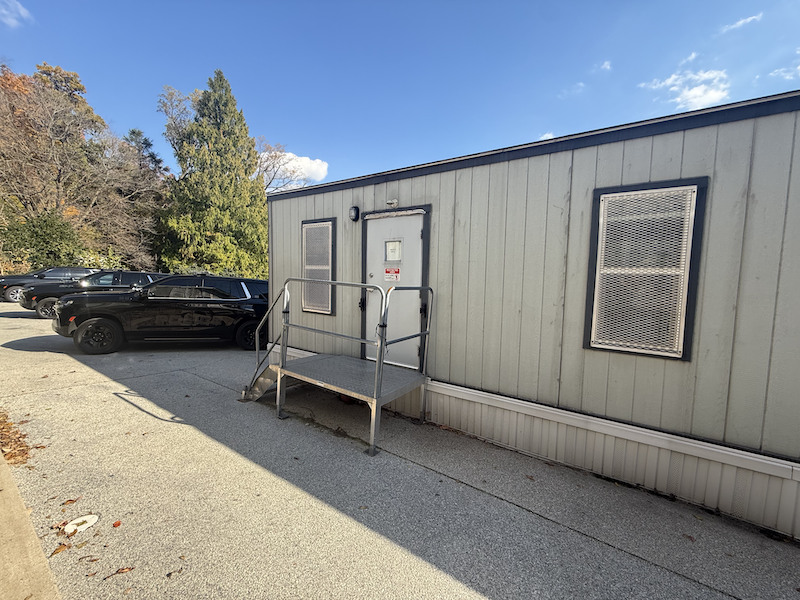
Officers have told township officials the trailer roof leaks during rain and snowstorms.
“Our detectives are in a trailer behind the building,” Sesher says. “There are serious concerns for their safety, not to mention there is sensitive information in the trailer which should be in a secure building.”
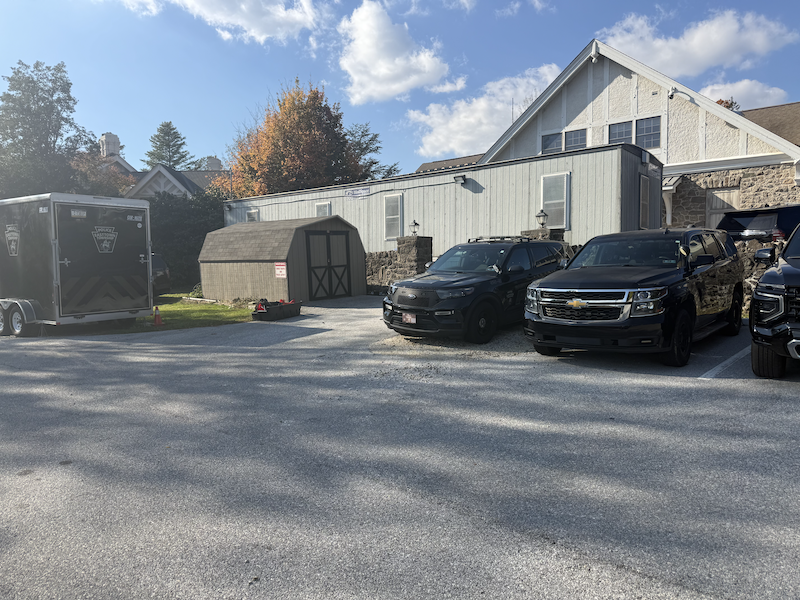
The exterior of the police stations shows storage sheds and trailers. Children at summer day camps have been known to wander into the police lot and play under vehicles, raising safety concerns.
Officer Hannah Kinsman put it plainly to supervisors in July: “This isn’t about giving officers a nicer workplace. It is about protecting evidence, providing privacy [to] victims during some of the worst moments of their lives.”
Plan A, then a pause
By 2022, after years of public meetings, supervisors were weighing a plan to knock down the carriage house and build in its place, at $15 million to $20 million. The Easttown Historical Commission raised concerns about losing the historic building.
The board balked at the price. The township had just raised property taxes more than 30 percent, and it had no way to pay for the building.
“They tapped the brakes,” Curley says, “with the idea of, we must be able to finance the building before we can build it.”
In 2024, the township adopted an earned income tax. Curley says the need for a new building and rising fire and EMS costs were the two biggest drivers.
Plan B: a bank barn on the hill
In 2025, supervisors hired Kimmel Architecture to take a fresh look, with a narrower assignment: fix the police station, fix the meeting room and leave room to grow.
The resulting concept plan puts a new building in the northwest corner of the property, near Newtown and Beaumont roads. Building on a separate site is cheaper than demolishing and rebuilding, and it lets staff keep working in the old building until move-in day, with no phased construction and no temporary trailers. The estimated cost is $12 million to $13 million.
“The best decision,” Curley says, “was also the cheapest decision.”
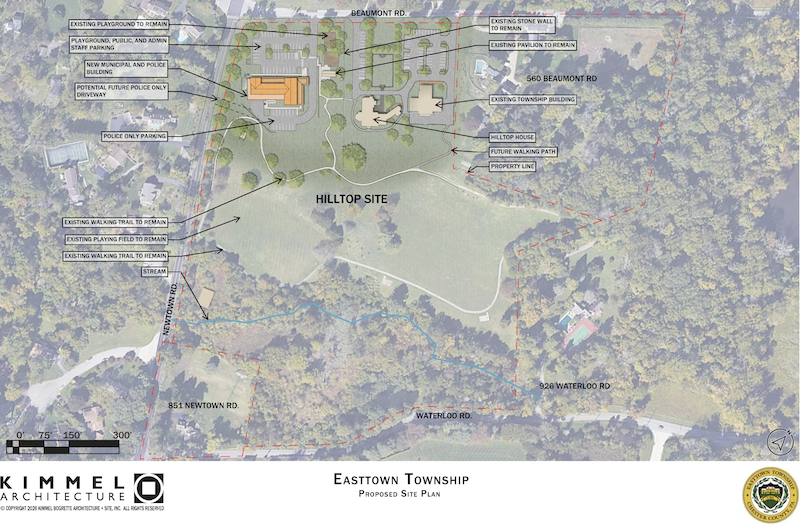
An aerial view of the HIlltop site shows the planned new municipal building in orange.
The building is designed as a Pennsylvania bank barn, built into the slope. Preliminary renderings show a roughly 20,000-square-foot building, with township offices on the upper level facing Beaumont Road.
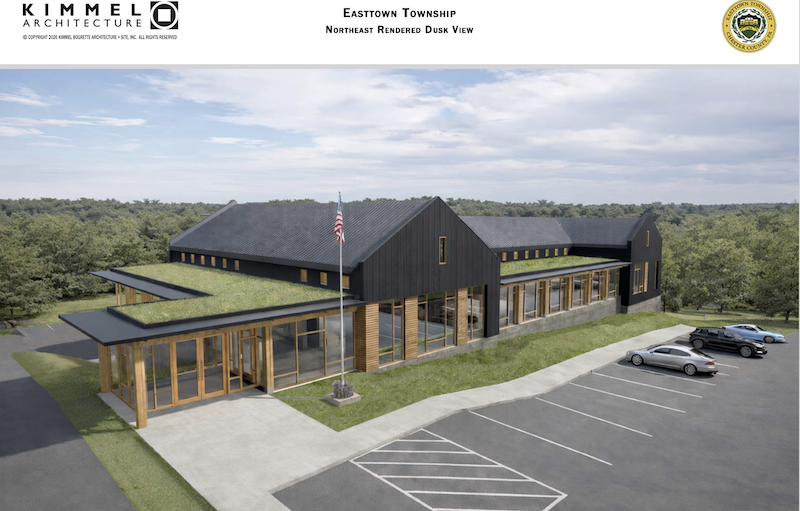
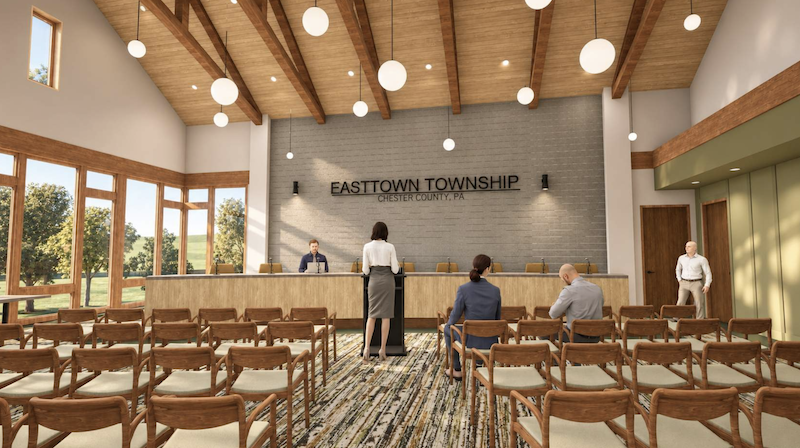
The building’s new meeting room, rendered below, can hold up to 55 people.
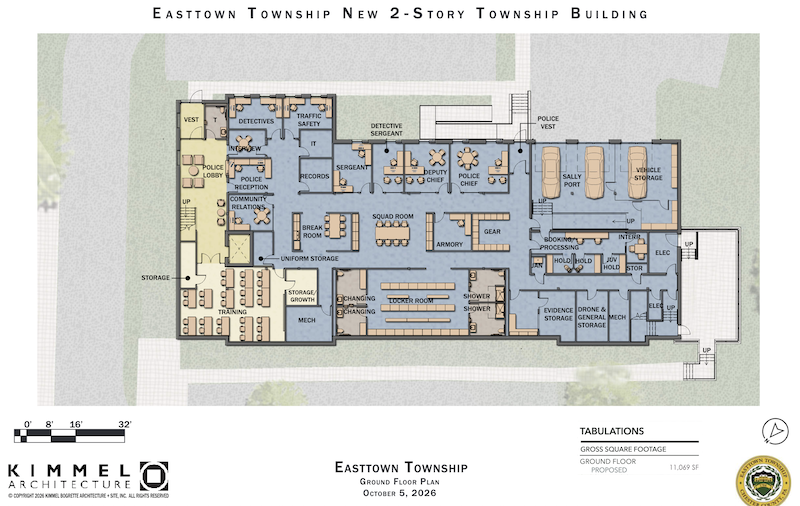
The 11,000-square-foot police station is tucked into the hillside below, with its own parking and a clear separation from the park. It has room for the department to grow from 18 officers to 25.
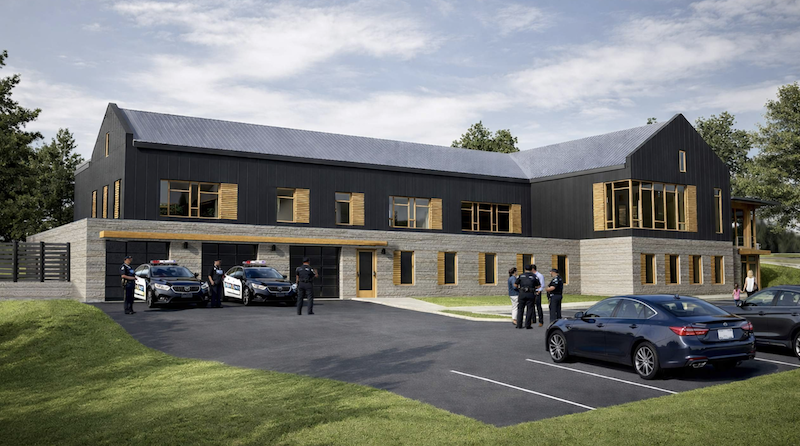
As drawn, the building is deep gray with board-form concrete accents, a green roof of native plants and a mass-timber structure, generally considered a sustainable choice. Those details could change during township approvals.
The Historical Commission likes what it sees. “The bank barn model keeps us in touch with the agricultural roots of the township,” says commission vice chair Anna Sicalides. “This is important because we have lost so many of our barns and outbuildings to development and decay.”
The old carriage house stays. The township plans to reuse it for public purposes, possibly community programming run by a nonprofit.
“I’m thrilled that the township will be adaptively reusing the current building and following the intent of our Zoning Ordinance and Comprehensive Plan,” Sicalides says.
Fact-checking the fears
Hilltop House. Curley flatly denies the online chatter that the mansion is endangered. The township recently re-landscaped the courtyard and extended Perfect Setting’s contract for six years.
“I don’t think anything that the township is doing in any way compromises or endangers Hilltop House,” he says. “Arguably one could say that the township is solidifying Hilltop’s role, not compromising it.”
Parking. Beaumont Elementary parents who use the park lot won’t lose it, Curley says. The lots will essentially swap roles: the park lot will serve the new township building, and the current township lot will become park parking, open to Beaumont families. “There’s no problematic loss of parking,” he says.
The park. It gains ground on the northeast side: The trailer, shed and storage area behind the current building is slated to “return to park.”
The money. Monday’s vote isn’t a “capital budget” vote. The project is already financed: on July 20, supervisors unanimously authorized a bond issue of about $22 million covering the new building, refinancing of the firehouse debt and sewer upgrades.
What’s actually on the table Monday
The vote is on a legal agreement between the township and the O’Dells’ heirs: Frances O’Dell’s surviving descendants and the representative of Sterg O’Dell’s estate. (He had no children.) The heirs have already signed it.
The agreement “clarifies” that the deed’s limit on new buildings doesn’t bar the new municipal and police building in the northwest corner. In exchange, the township commits for the first time to preserving Hilltop House itself, along with the playground and gardens north and northwest of the house. The southern walking trails, the large southern playing field and the southeastern open space must also stay open to the public.
In the agreement’s own words:
“…the Building Provision in Section 3 of the Vesting Deed… was not intended to, and shall be not be construed to, prohibit the Township’s construction and installation of an additional building in the form of the New Municipal and Police Building on the northwesterly portion of the Property…”
“…Township agrees that the historic ‘Hilltop House’ structure, and the playground and gardens to the north and northwest of Hilltop House, as shown on the Plan, shall continue to be preserved in the future.”
The agreement runs with the land and will be recorded with the county.
What’s next
If the board approves the clarifying agreeement, detailed design should wrap up in the spring, followed by land-development approvals, bidding and roughly 18 months to two years of construction.
Have a concern? Speak up at a township meeting or email the supervisors. Just don’t dress up a polemic as a news article. Facts matter.

Thank you Caroline for getting accurate information out there. It was very frustrating to see bad information being circulated about this project. I represented the Historical Commission during “Plan A”, this is by far a better plan and preserves one of our historic assets while giving residents and the police a space that functions for 2026 and beyond.
This is a certainly a last ditch effort by the board. The board (and the town lawyer) knew about the deed restrictions and decided to go ahead anyway without so much as “may we please” before spending town funds on an architect and getting a bond issuance started. Once somebody from the public points at the deed, they started scrambling. The board has decided it wants a new building and damn any voter objections or legal obstacles. Not a good look for the town. In any event, it will be interesting to see if Vassar College (the beneficiary of the deed if it is violated) has other ideas.
I carefully read the agreement that representatives for the living descendants of the O’Dells (the folks who donated the Hilltop property 30+ years ago) signed and it specifically allows the new building. I quoted it at length in my article and it is available for anyone to read on the township’s website in the agenda packet for Monday night’s meeting. Presumably a signed agreement like that, crafted by attorneys, overrides the deed restrictions and thereby precludes the possibility of the land going to Vassar. I would be surprised if Vassar pressed the issue with a signed agreement like that. Seems like a stretch.
Let’s merge the town with https://www.tredyffrin.org/Home.
At this point there is no difference in policy (spend other people’s money as fast as possible on unneeded public works) and no tax advantage.