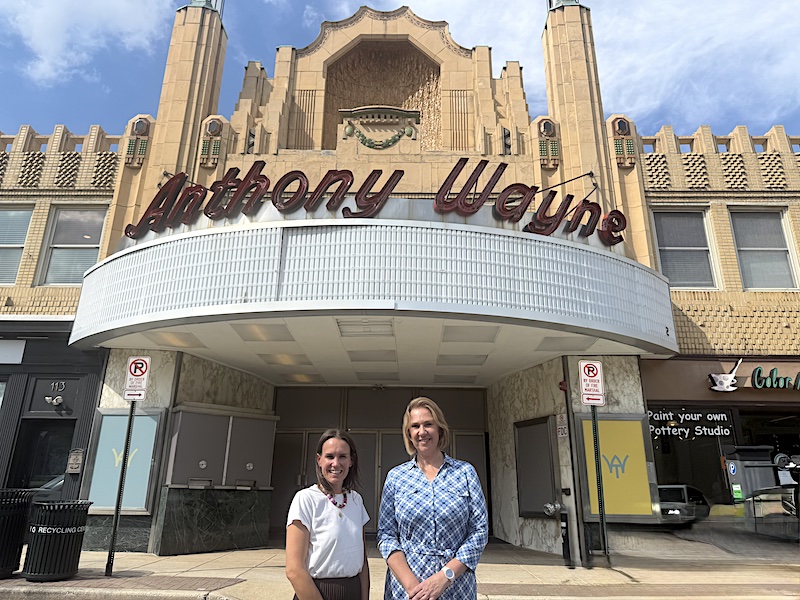
As of this summer, the fledgling Anthony Wayne Theater (AWT) currently has two employees, both of whom live in Wayne: Development Director Michelle Johnson (left) and Executive Director Jennifer Carlson. Johnson came from People’s Light and Carlson from the Colonial. The nonprofit is governed by a board of directors.
If you could conjure, à la Dr. Frankenstein, the ideal person to resurrect a landmark local theater left for dead, you’d likely land on someone just like Jennifer Carlson.
A standout leader at Phoenixville’s Colonial Theatre, Carlson arrives at the Anthony Wayne uniquely equipped for a challenge she calls “Herculean”: raising millions of dollars, overseeing the overhaul of a derelict movie house while honoring its history, and building a loyal audience with the right mix of movies, programs and performances.
Fortunately, she’s tackled pieces of this puzzle before. Stints at Temple, the Walnut Street Theatre and People’s Light sharpened her stage management, box office and marketing skills. Historic Philadelphia Inc. gave her programming experience. And her last three executive director roles — at Wyck Historic House in Germantown, the Connecticut River Museum, and, most recently, the Colonial Theatre — built her fundraising and event-planning chops.
Raised by a single mother in Lancaster and York, Pa., Carlson first fell for old movie palaces as a teenager, watching Marilyn Monroe films at the circa-1906 Capitol Theatre in downtown York. Her fascination with the Anthony Wayne’s Art Deco “bones” and pedigree — architect William Harold Lee, with draftsman Louis Kahn — was obvious as she led me through the dark, dusty complex, flashlight in hand (below).
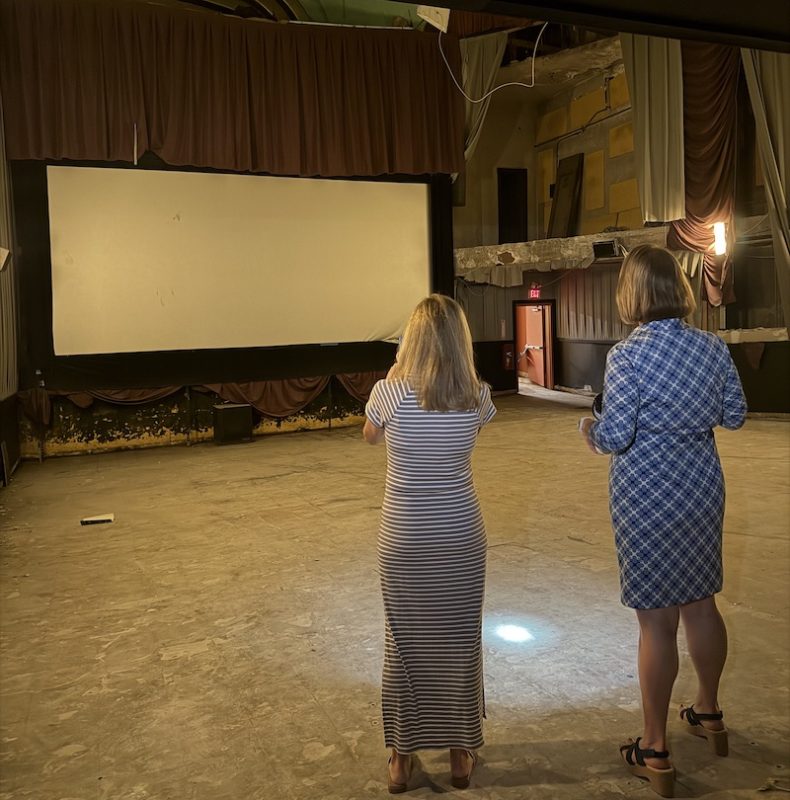
Some corners were downright spooky, prompting mentions of Nancy Drew mysteries, The Phantom of the Opera, Michael Jackson’s Thriller and Eastern State Penitentiary. Afterward, we sat at a folding table in the once-grand lobby for an exclusive one-on-one.
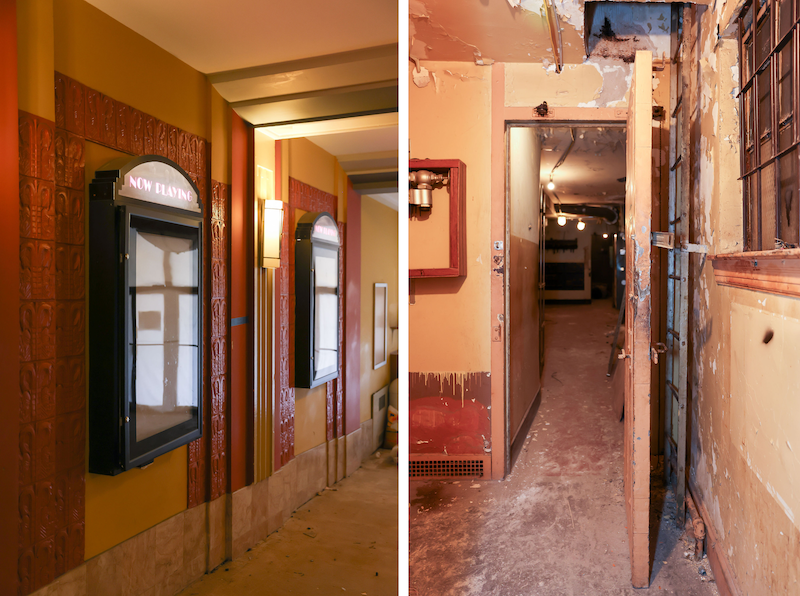
The long empty foyer and an upstairs hallway. (Jenny Ham Studios LLC photos)
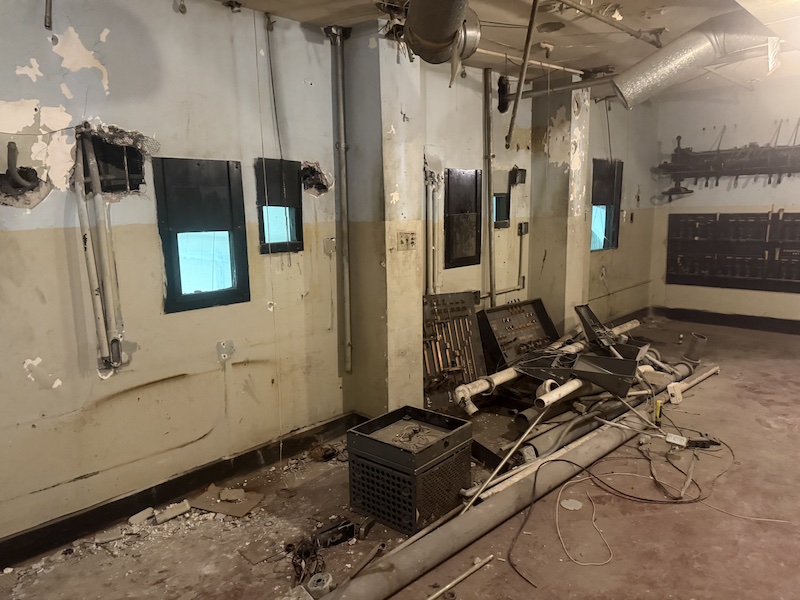
The original projection room when the Anthony Wayne was a one-screen theater.
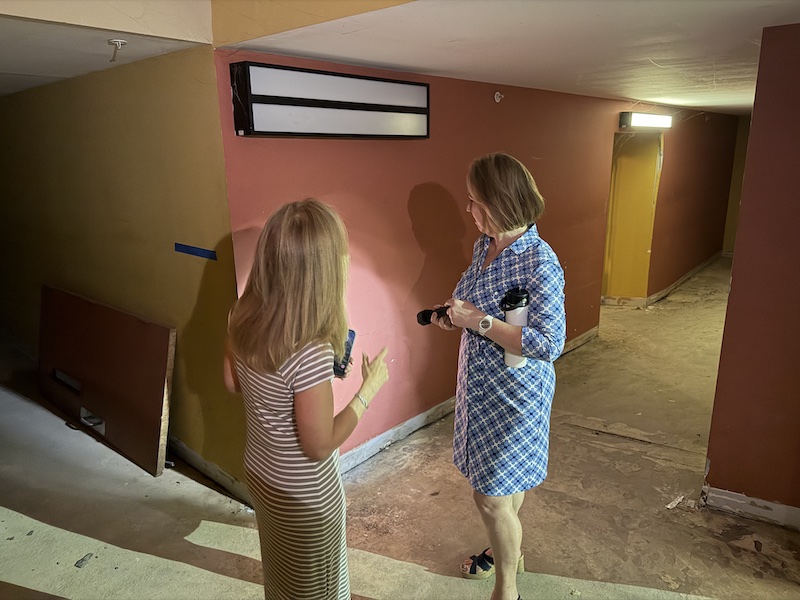
A hallways with signs that once listed movie titles in what was then a five-screen multiplex. The theater opened with a single grand auditorium with 1,600 seats on June 20, 1928.
Here’s our conversation, lightly edited for brevity and clarity:
What drew you away from the Colonial Theatre to take on this project?
I started at the Colonial in 2022, right after COVID, when people were still getting comfortable going back to theaters. There was a lot of work — redesigning programming, fixing deferred maintenance. I felt things had really stabilized and strengthened there. I started hearing more about the Anthony Wayne Theater and seeing the building. I’m someone who really loves a challenge, and I love old buildings and what they can do for communities. I also saw the up-swell of support for this, and knew that a board was already doing a lot of work to make this happen. I thought, “OK, I think we can do this.” My husband and I also happen to have moved to Wayne from Phoenixville about a year and a half ago – so this felt like a natural next step, too.
Any lessons from the Colonial you’re bringing here?
Be flexible with programming, and really listen to what your patrons — and people who aren’t patrons yet — are interested in. It’s not that I don’t have a vision, but I think it’s critical to hear what people want, and how the arts might tie into their other interests. For example, some theaters have done movie nights where people can knit or crochet while watching. This fall we’ll be at Porch Fest and Fall Fest in Wayne specifically to start that listening process — find out what people want to see here.
That also means having a strong programming director who isn’t ego-driven about their own pet series, but is asking: what’s actually going to bring people in the door?
How have you felt in recent years seeing so many historic theaters fall into disrepair and eventually closing?
Sad. Really sad. That was a big fear right after COVID, with movie viewership really going down — could some of these independent historic venues survive? I think that’s why I’m so committed to staying agile with programming and keeping on top of trends. I always tell people to think about the Colonial: it opened in 1902 for live theater and vaudeville. We don’t still do vaudeville. Then film came along later. Theaters have always had to adapt, and we have to keep adapting as things change.
What’s interesting is that in 2026, movies have done excellently at the box office — higher, I think, than 2019. So there’s clearly interest in going to the movies again. And I think independent cinemas especially have found ways to eventize movies, making them more of an experience than just watching a film — one you’ve seen a thousand times and could just as easily watch at home while doing laundry. People would rather come see it with a group and have fun. So I do think the time is right.
What’s your vision for the space, programmatically? We see it as a multi-arts venue. Film will still matter a lot — there’s real nostalgia in this community for seeing movies here — so we want a mix of new-release and repertory film. Having a range of theater sizes helps, since new releases typically have to run two to five weeks under studio contracts.
Arts education for kids also keeps coming up. We’re hearing from parents who’d want structured activity for their kids — a filmmaking or theatrical workshop — while they get a date night down the street.
We’re also looking at speaker series and author events.
One of my first questions when I started talking to the board was whether this was meant to be purely a film venue, because I don’t think that works next to the Bryn Mawr Film Institute, and it’s not where audience tastes are today. Since I’ve been involved, this has been conceived as multi-arts.
Will you look at the Colonial or Bryn Mawr Film Institute as models for AWT in any way?
I want to be careful not to copy either, since we’re all so close geographically. The Colonial’s largest theater seats 658; ours might have 200, so we’re not competing on that scale for live events. Both the Colonial and Bryn Mawr have 35mm projection, and Bryn Mawr has 70mm — we won’t have that niche. So I’m balancing what this community wants with where we can be additive rather than duplicative – especially with more people moving to the suburbs and demand growing.
Will there be stadium seating and reclining chairs?
There’s talk of it. Eventually, there may be a chair-naming campaign. As much as we talk about community and connection, if someone is brutally uncomfortable, that’s not going to work.
Where does fundraising stand?
Our goal right now – pending final plans and cost escalations – is $15 million. We’ve raised 20% of that so far. We’re hoping to finish the quiet phase of fundraising by the end of the year, ideally getting to 50% before we go public. When we do launch publicly next year, we’d also like to announce some public programming – free outdoor films, potentially in partnership with the township – so people can see us engaging with the community even before the doors reopen.
I can’t speak to specific donors because of confidentiality. It’s not necessarily about landing one big seed funder – it could be one large gift or a series of gifts. I wouldn’t say no to either.
How will you open fundraising to smaller donors?
That’s part of what we’re planning for the end of this year — what the public launch looks like. You’ll be able to donate through our website. Once we go public, we want to be able to show people we’ve already raised half or more, so the ask becomes about getting us over the finish line rather than starting from zero.
Can you break ground before you’re fully funded?
I really don’t want to do that. The usual guidance is not to break ground without at least 80% of funding – I’m pushing hard for us to hit that before setting a groundbreaking date, so we don’t take on debt we’d struggle to pay back. You can also lose donor momentum once you break ground. Any debt we take on should really just be short-term bridge funding while pledges come through.
What about naming rights?
We’re close to finalizing those – the three theaters, the “top-notch” concessions area, and some smaller spaces – will all be naming opportunities at different gift levels. Some people with a sense of humor might want to name the restrooms. But we’re starting with the bigger leadership gifts first.
Any community fundraisers planned?
Most likely next year. We’re looking at fun public events on- and off-site. Given how this place looks, maybe something built around Halloween.
Are you pursuing grants?
Yes — they’re not always plentiful, but we’re looking into a range of opportunities, including applying to Radnor Township for help with public programming. As a new organization, some grants may be harder to land right away, but we’re pursuing brick-and-mortar grants too.
Is there anything that would surprise people about reviving and running a nonprofit theater?
People are often surprised by the ins and outs of contracts with studios and artists — and why fees are attached to tickets. A common question is, “Why don’t you just raise prices if you’re fundraising?” But for movie tickets, distributors typically take a large cut – often around 64% for new releases. So raising the ticket price mostly means giving more to the distributor. The fee, separately, covers things like credit card processing and the ticketing platform. That’s why independent and nonprofit theaters try to keep fees low rather than padding ticket prices. For live shows, if it’s a high-priced concert, the fee itself might run $8-$9, and sometimes there’s a ticket-split arrangement with the artist. So raising prices doesn’t necessarily help the theater – which is why we still rely on sponsors, donations, and members.
There’s also a misconception that paying in person or with cash avoids fees. In reality, with the ticketing and payment systems theaters use today, those processing costs exist regardless — similar to how many restaurants now add a surcharge for credit card payments, often around 8.5%.
The other surprise is that theaters can’t just book any movie they want. When I started at the Colonial, I didn’t have much experience in film exhibition and assumed if we wanted to play something, we could. But you have to license it — and distributors sometimes restrict where a film can show, even in ways that seem arbitrary, like allowing it in Philly but not the suburbs. It can be frustrating when patrons want to see something here and we simply can’t get the rights, for reasons that have nothing to do with us as a theater.
What’s the timeline for breaking ground and opening?
It’s very tied to fundraising. In an ideal world, we’d have something significant open by 2028 — the theater’s 100th anniversary (it opened in June 1928). Realistically, we’re hoping to finish the quiet fundraising phase this year, launch publicly next year, and let the timeline follow from there. We don’t want to be hasty — we want this to be sustainable — so we can’t put a hard date on groundbreaking yet.
How can the community get involved right now?
Come find us at South Wayne’s Porch Fest [Sept. 19} and Radnor Fall Fest{Sept. 20] – we want to hear what people are interested in. People can also email me directly at jennifer@anthonywaynetheater.org, sign up for our e-newsletter, and follow us on social media.
We’d also love to hear people’s memories of the Anthony Wayne — first kisses, watching Jaws here, that kind of thing. Those stories are great for us to share as we build out regular communication.
And if people want to donate any amount, or volunteer once we start public programming next year, they should reach out — we don’t have a donate button up yet, but we’ll take support any way it comes.
A lot of this campaign so far has happened through word of mouth — people hearing I’m connected to the theater and seemingly coming out of the woodwork excited about this reopening. It’s mind-boggling how many people who don’t seem like obvious donors have a real nostalgic connection to this place and want to see it revived.
Our goal is to have everyone to feel welcome here. Whether you come by yourself or with your family, to know you’re going to have a good time.
Anthony Wayne Theater, a 501©3 nonprofit, welcomes your ideas, memories of the old theater, and donations. Contact Executive Director Jennifer Carlson at jennifer@anthonywaynetheater.org or Development Director Michelle Johnson at michelle@anthonywaynetheater.org.
A great article Caroline! This is so exciting that the Wayne will be coming back.
In the late 1950s/early 1960s there was a candle shop run by Mae Raab ( My spelling might be off) located in the small shop on the East side of the main entrance. I worked for her as a part time “stock boy/gopher” during the Fall of 1961 during the Christmas rush while I was in High School. My first actual “job”…